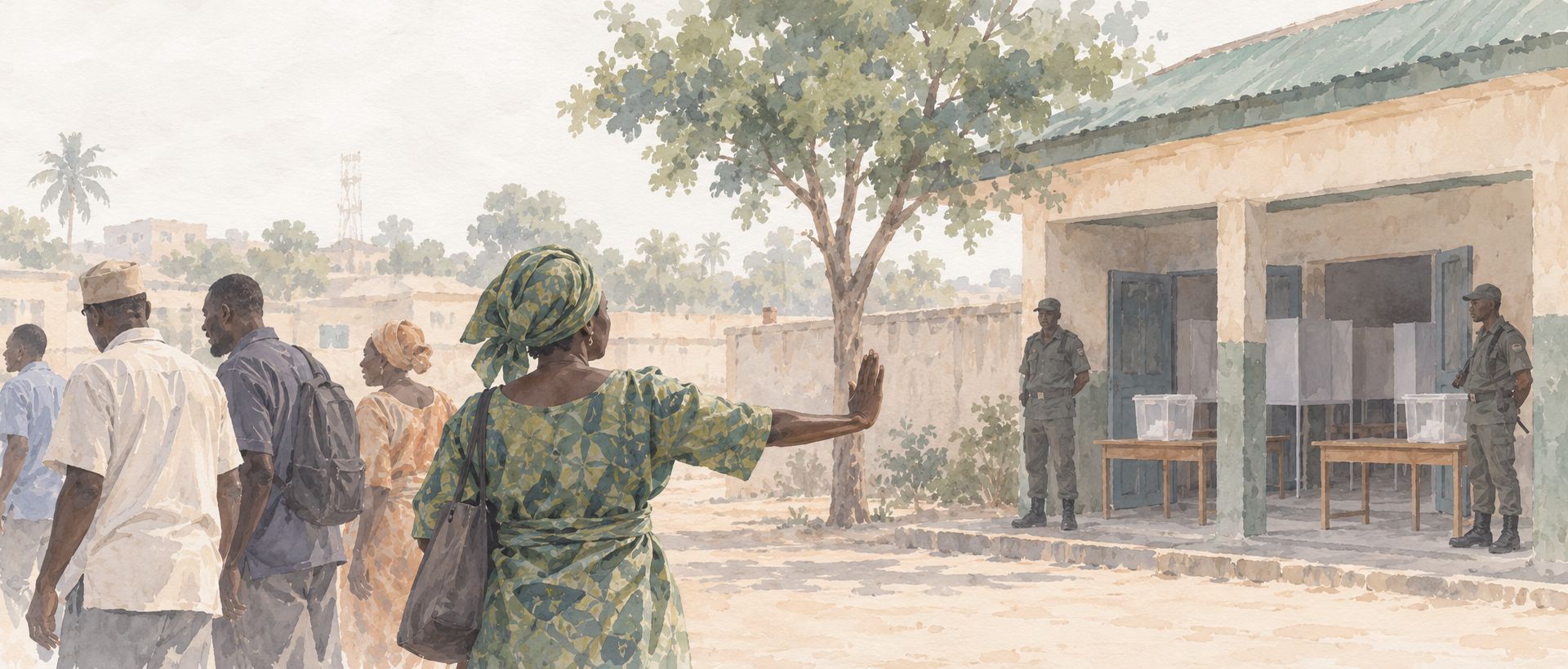
 Photo: Chat GPT
About the project
Democracy is in retreat around the world, and more than two-thirds of the world’s population now lives in autocracies. Opposition leaders do not sit idly by. One common tactic is to boycott sham elections and mobilize protest movements to force the incumbent to make concessions. Since 1945, at least some opposition candidates or parties have boycotted 9% of all national legislative, executive, and constituent assembly elections worldwide. Yet the effectiveness of these boycotts varies radically. While the opposition’s boycott of the 1996 parliamentary election in Bangladesh forced the incumbent to call fresh elections, the Guinean opposition’s boycott of the 2020 legislative election fell flat and allowed President Alpha Condé to capture a parliamentary supermajority. Why are some election boycotts more successful than others?
Existing research has mostly examined why opposition parties boycott elections, and has paid far less attention to what boycotts achieve. Where studies have considered boycott outcomes, they have typically evaluated them against broad outcomes such as democratization or regime change. This project instead evaluates boycott success against the boycotting parties' own stated objectives, the norm in research on nonviolent campaigns. This approach captures the many concessions short of full democratization that boycotts can win.
By providing evidence on when and how election boycotts win concessions, the project offers insights for policymakers, election observers, and democracy advocates who seek to understand which strategies best preserve and consolidate democracy.
Research design
The project proceeds in three phases. In the first phase, the project team draws on in-depth knowledge of election boycotts in Burkina Faso, Burundi, Côte d’Ivoire, and Guinea, together with exploratory field research and expert interviews, to conceptualize what boycott success looks like and how it can be measured.
In the second phase, the project constructs the Election Boycott Characteristics and Outcomes (EBCO) dataset, an original dataset of all election boycotts worldwide between 1945 and 2024. EBCO records the organizers, stated objectives, accompanying tactics, regime responses, and outcomes of more than 400 boycotts of national executive, legislative, and constituent assembly elections, and forms the basis for descriptive and statistical analyses of boycott success.
In the third phase, the project builds on the statistical findings to examine the mechanisms through which boycotts win concessions, using process tracing based on field research and interviews with opposition and government leaders in strategically selected cases. The EBCO dataset will be made publicly available upon completion.
Book project
Election boycotts are commonly dismissed as a sign of opposition weakness: a futile gesture that hands the incumbent an easy victory and leaves the opposition on the margins. In this book, I challenge that view. I argue that election boycotts are a strategic act of electoral noncooperation that opposition actors use to oppose the regime-strengthening functions of elections. Drawing on the EBCO dataset, case studies, and interviews with opposition leaders, the book follows the full boycott cycle, from the decision to withdraw, through how the opposition wages the boycott and how the regime responds, to what the boycott ultimately wins. The result recasts election boycotts as resistance rather than resignation, and shows that opposition actors can, under the right conditions, win from the sidelines.